

Out of my head on the eighth day of a headcold of biblical, Qur’anic and Talmudic proportions (מי האף, nasal mucus, of which the Merciful One included among the impure bodily fluids), I have almost reached the apocalyptic moment, Christmas dinner, when all of creation stands still and the assembly, crackers cracked, paper hats donned, tucks with great abandoned relish (and other condiments) into oysters, fin-free, unscaled, half-shelled; smoked salmon and foie gras; turkey with her endless trimmings; cheeses from both sides of La Manche; and last year’s Christmas pudding (or is it the year’s before?) inflamed with whisky and doused with a wallop of Bird’s.
While preparing all this I have also prepared the tale below, borrowed from the Gospel of Pseudo-Matthew, which, like the מי האף, pours forth out my fevered head at this time of year for reasons that escape all Reason. It is to be followed, some day, with tales from the Infancy Gospel of Thomas, whose sharp, punitive, and reckless Infant randomly withers and kills – and heals – with volatile impunity.
No one tells these Christmas stories. They are my favourites. I’ll no doubt lose a host of subscribers for sharing them, but what the hell. It’s Christmas! And a new year beckons!
When the girl turned fourteen, the Sanhedrin, following the dictates of Pharisee law, declared her unclean, barred her from the temple, and held a contest to find her a husband. Suitors came from all the tribes, for everyone in the country loved her and always had: as a toddler, the grown-up way she walked and the perfection of her speech astonished those who witnessed this, as did the diligence of her devotions. She behaved not like a child, but like a woman in her thirties, so beautiful that few men could meet her gaze.
The high priest collected the rods of all the unmarried men and placed them in the most sacred chamber of the temple. “Come back tomorrow and reclaim your rod,” he told the assembly. “The man from whose rod a dove emerges will be entrusted with the girl for safekeeping.”
The next day, however, when the men came to reclaim their rods, no dove was forthcoming. A voice spoke to the priest: “You overlooked the shortest rod. You brought it with the others, but did not remove it with them. When you return it to its owner, the sign will appear in it.”
The short rod belonged to Joseph, a widow so old and spent he seemed set aside, as if he could not receive her. When the high priest saw him hiding at the back of the line – for Joseph did not wish to reclaim his rod – he called to him loudly: “Joseph, get over here and take your rod. We’re all waiting.”
Joseph approached, trembling at the priest’s loud summons, and as soon as he touched the rod, a dove brighter than snow emerged from the tip, circled the temple roofs, and rose toward the heavens. Everyone rejoiced.
“Take her,” the Sanhedrin said, “because you alone among the tribes have been chosen.”
“I am an old man with many children,” said Joseph. “Why hand over to me an infant, younger than my own grandsons?”
“Do you despise God’s will?” they asked angrily. “Do you reject His word?”
“No, no, of course not,” he said, backpedalling. “But I’ll just be her guardian until I figure out which of my sons should take her as his wife. In the meantime, let a few maidens from her circle accompany her for companionship and consolation.”
The old man and the girl went back to Nazareth, where Joseph was the local tekton, a handyman. He worked seven days a week and had no assistance from his sons, idle drunkards to a man, each with several wives. To feed everyone, Joseph had to take whatever job was available, no matter how difficult it was. Or how humiliating. Unblocking drains, for example, emptying outhouses, or cleaning out livestock stalls. Sometimes he did light repairs, jobs too small for the bigger crews to bid on. He also took on roofing and renovation work that required long travel to the hilltop settlements or the coastal districts. He was often away for months.
Once, upon returning from a house-building job in the panhandle, he found the girl nine months pregnant. “O Lord,” he said in distress, “take my life; I’d rather die than live another day like this.” The girl’s maiden friends rushed to him and said, “Joseph, what are you saying? No man has touched her; we have watched over her; there can be no sin in her. It could only have been the angel that made her pregnant.”
Then said Joseph: “What angel?”
The girl, they said, had been talking about the angel for months. She described it as a “young man of ineffable beauty” who gave her and only her magical things to eat. No one else ever saw him. Joseph asked the girls: “Did someone pretend to be an angel and beguile her?” The girls said no, they didn’t think so. He confronted his sons, and then his grandsons; each swore on the memory of his dead wife that they hadn’t touched her. Joseph spoke again, tears in his eyes and: “How can I go to the temple and face the priests? What should I do?” He thought about leaving and sending her away, but news of the girl’s state had already reached the Sanhedrin. They sent two officers, who arrested the couple; the girl was forced to stand before them at the altar with her hair loose – the mark of shame – and told to hold her husband’s meagre offering – cheap barley, the lowest grade, feed for beasts – in her cupped hands. “No one,” the priests told Joseph, “gets answers from God without first giving something in return.” To the girl, they said, “This is yours now, it is of you, your offering to yourself, a bitter meal of your iniquity and your husband’s jealousy and humiliation.” Joseph was afraid, and the girl didn’t understand, but she did as she was told. “Drink this,” the head priest said, holding out a clay pot. “Water of the Lord and dust from His temple floor,” he said. “If its bitterness does not make your womb fail, you are spotless.”
By now, a crowd had assembled, a multitude of people beyond number, but still she was not afraid. The night before, while filling a vessel of water at the fountain, the angel had prepared her. “Fear not,” it said, “for you alone have found favour. You shall bring forth a King who fills not only the earth, but the heaven, and reigns forever.” She took the clay pot and drank the bitter water and walked around the altar seven times – for this is what was asked of her – and no spot was found in her. Thus was her chastity proven. The empty vessel was smashed on the ground.
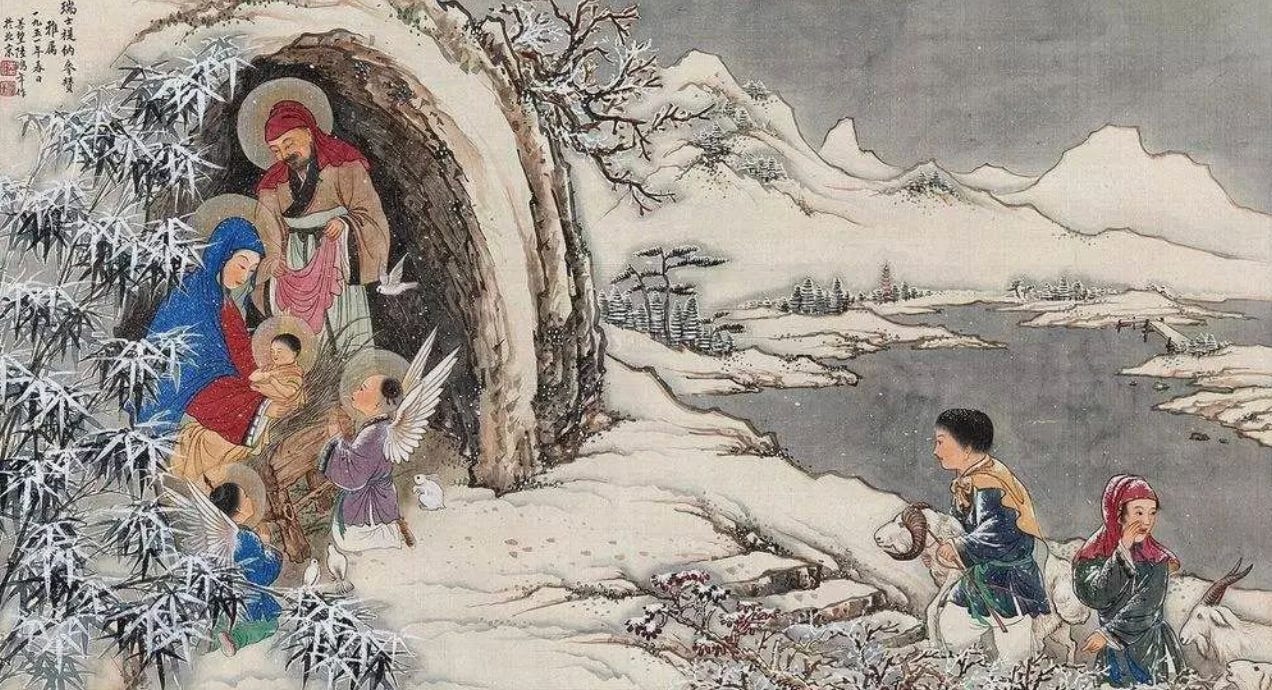
And then it came to pass a while later, on the road to Bethlehem for the enrolment, that her time came early, before the town was even in sight. Joseph put her in a cave, guarded by his drunken sons, and set out to find a midwife. The dark cave began to shine with as much brightness as if it were lit by the noontime sun. Again, all creation stood still. Joseph returned with a midwife, and at the cave’s mouth, a cloud covered it, and a brilliant light filled the entrance, and suddenly, there was the girl, with the infant at her breast.
Joseph and the midwife marvelled at the miracle, but a second midwife insisted on examining the girl; as a sign of her unbelief, her hand withered. She shrieked in pain and begged for forgiveness, and an angel appeared, telling her to touch the child; upon doing so, her hand was healed.
There will be more withering and healing to come. Until then, may peace and joy be yours.
MERRY CHRISTMAS EVERYONE!
I've noticed a big come back for the phrase "Merry Christmas"... it was out of fashion for many decades .. but I'm happy to see it return .. so I too say to you and your followers... Merry Christmas!
Get well soonest!!!