

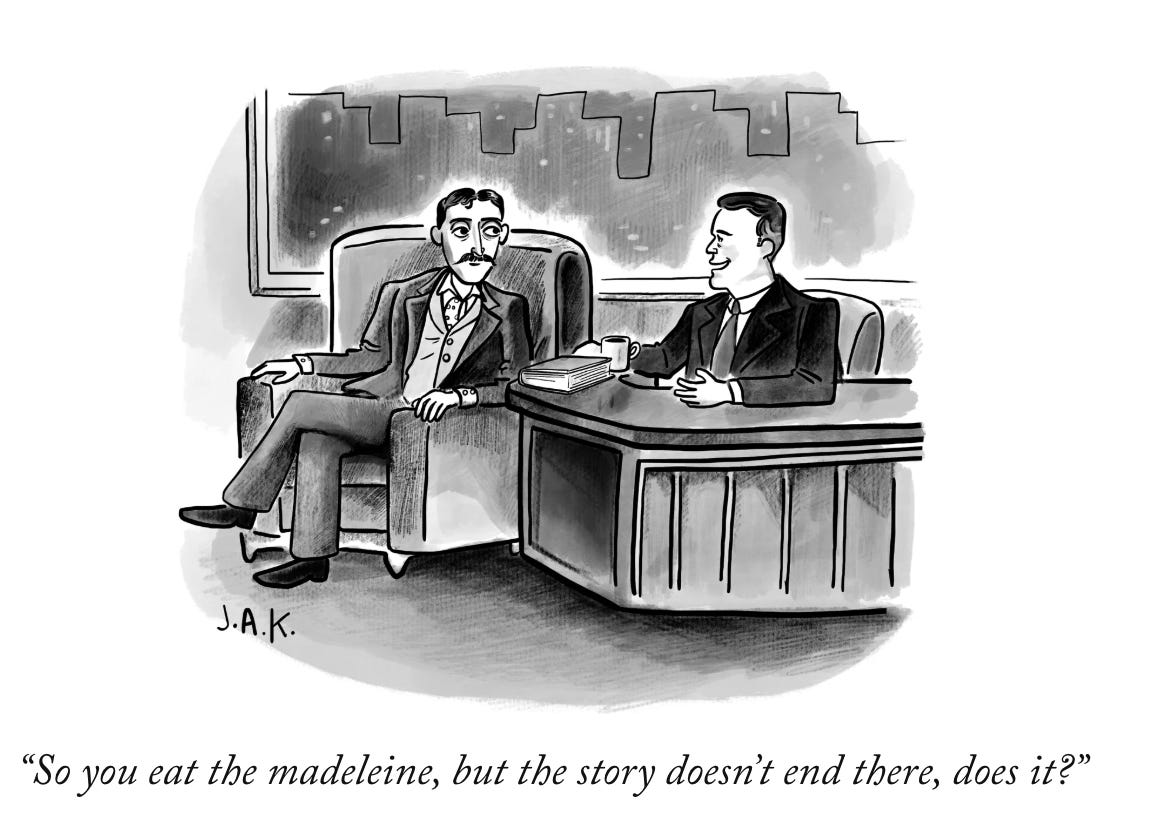
I’m hosting the first Raie, Menthe, Roux, Sel dinner tomorrow night. My guests include Proust’s neighbor, Raymond Roussel (1877-1933) (Thomas Landbo); his mother, Marguerite Roussel (1846-1911) (Sarajeanne Drillaud); the very much alive and thriving composer Richard Sears (whose soundtrack for Mémoire de fille (A Girl’s Story), a feature-film adaptation of Annie Ernaux’s book by Judith Godrèche, was presented in the Un Certain Regard section at Cannes last month); and the equally vital videographer and filmmaker Chloé Finch. Absent will be the French psychologist and philosopher Pierre Janet (David Dupuis-Moatti), best known for his pioneering theory of dissociation, early work on hysteria and hypnosis, and the case study he wrote about the psychological traumas and tribulations of Raymond Roussel. He’s stuck in Lausanne.
The meal will be a modest affair by Raymond Roussel’s standards: 7 courses instead of the usual 22‑course repas en chaîne he sat down to regularly in 1926 (which, coincidentally, was exactly 100 years ago and also the very year Janet published the case study).
All the dishes will be cooked, served, and scullioned not by a Rousselian‑sized kitchen brigade (chef‑cuisinier, tourier, entremettier, marmiton, plongeur, femme de cuisine), and dining‑room staff (maître d’hôtel, three valets de pied, two domestiques de salle), but by me, tout seul, armed only with Escoffier’s Le Guide culinaire, Google, Chat-GPT, a 5‑quart Instant Pot, a Ninja Dual Zone double‑compartment air fryer, a KitchenAid Artisan Series 5‑qt Tilt‑Head Stand Mixer, a Cuisinart Smart Stick Variable Speed Hand Blender, an all‑in‑one cooking Thermomix robot knockoff from Lidl, and the Falcon Classic Deluxe 90‑cm “piano de cuisson with 5 induction zones, two electric ovens, and a separate grill, combining a traditional range‑cooker look with modern induction technology.
So I’ll be fine.
Here is the menu:
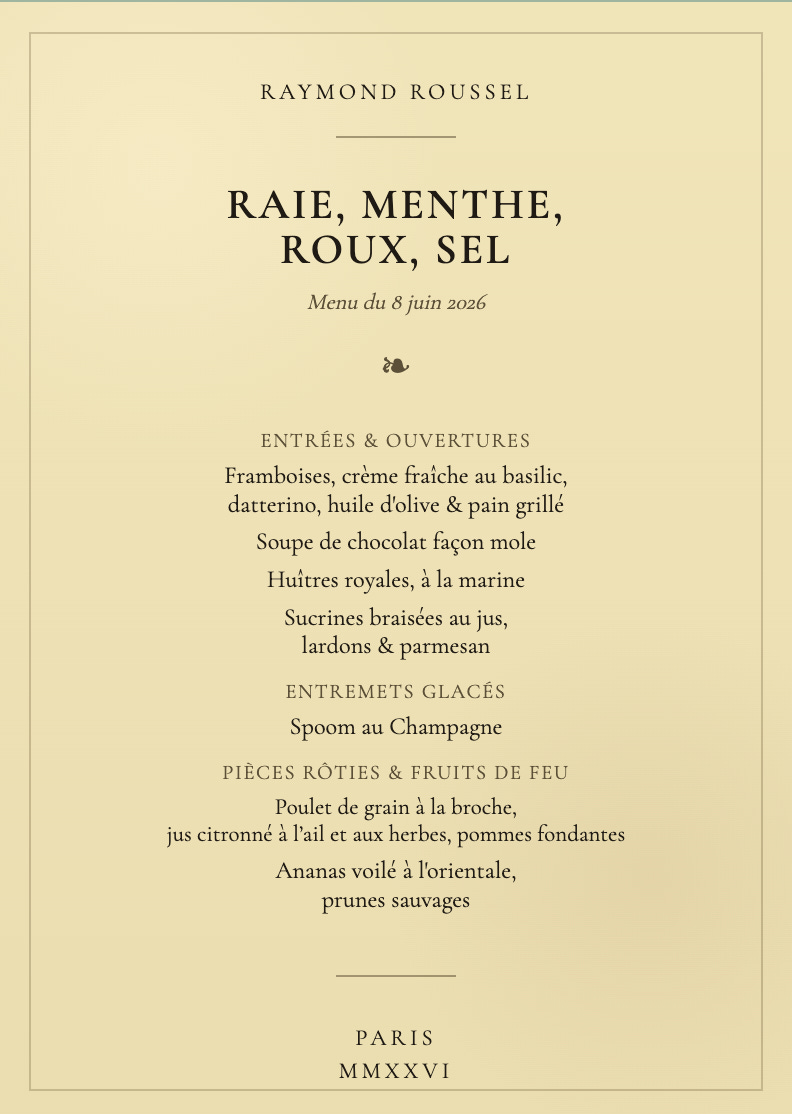
These dishes are based on a menu I found in the pages of La Grande cuisine bourgeoise (1976) by André Guillot:
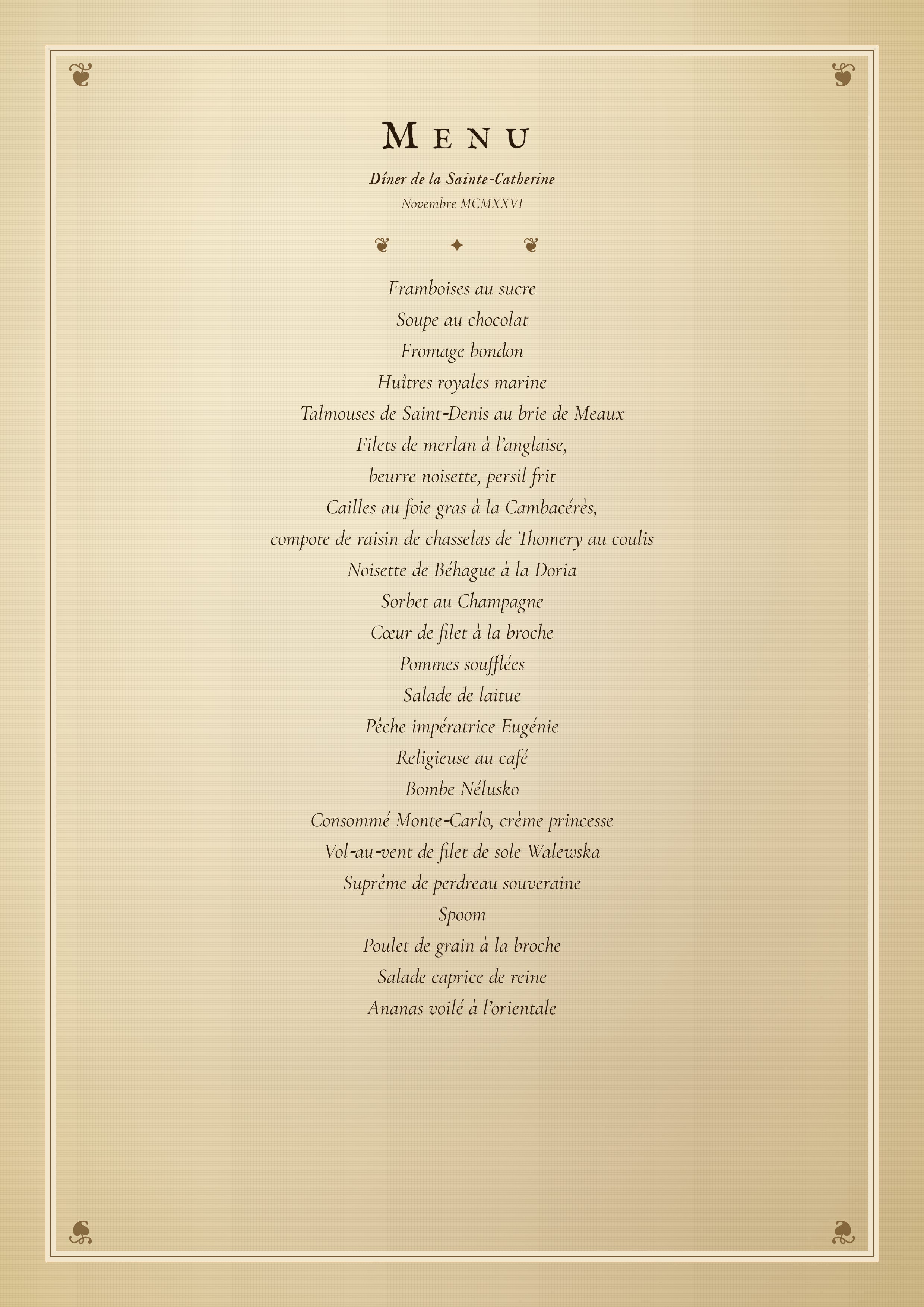
Guillot (1908–1993) was an early pioneer of “nouvelle cuisine”–style light cooking. He is especially known for: eliminating flour‑based roux from his sauces; championing local over exotic products; maximizing menu diversity; strictly avoiding waste; and working at 18 in the kitchen of Raymond Roussel, where most dishes were returned untouched.
The pertinent excerpt from La Grande cuisine bourgeoise (which every serious cook should have):
On a sunny October morning in early 1926, the trees of the nearby Bois de Boulogne smelled sweet, and a few leaves had begun to fall. The Val d’Or tramway, noisy yet pleasantly distant, rattled to a stop near the property of Mr Raymond Roussel on boulevard Richard‑Wallace in Neuilly.
Roussel was an extraordinarily wealthy writer and surrealist figure, an eccentric of the first order, about whom François Caradec has recently written a biography.
A low wall separated the garden from the pavement; the villa itself was set back, its kitchen windows just above ground level. To the right of the entrance stood the outbuildings where Roussel’s famous caravan with its bathtub was kept, the one that had served him on his journey across Africa.
On the right, an iron gate led into the property. I presented myself to the chef, a taciturn, surly man with a moustache and a flattened toque. He hired me as first assistant. I was eighteen.
In the centre of the rectangular kitchen stood a large white table, with a chopping block at one end. The range, with its grill and spit, ran beneath the windows. The pastry kitchen lay on one side, the chef’s office and the cold‑room on the other, and there was a dining‑room for the chauffeurs. In another corner was the dumbwaiter.
The rule was strict: absolute silence. Everyone kept his mouth shut—chef, second assistant, kitchen boy, valet‑de‑chambre, gardeners, and chauffeurs. The work was extremely demanding. The master took only one meal a day, from 12:30 to 5:30 p.m. The staff ate at 11:30 a.m., 12:30 p.m., and 6:30 p.m.
There were never any guests. Roussel always dined alone. The household staff was large: three chauffeurs, three gardeners, a butler, a valet‑de‑chambre, two footmen, a linen maid, a governess, and three cooks.
Without fail, Roussel began his meal at 12:30 with fruit from his estate in the Alpes‑Maritimes. Then came soup—soup with tea, soup with coffee and milk, soup with chocolate. After the soup there was cheese (Bondon from Neufchâtel) and then—well—a fish dish with shellfish, a fish relevé or a farinaceous course, garnished entrées, often two of them, a sorbet or a pudding, a roast, a vegetable, a mixed salad, and a fruit dessert.
Next came the “snack”: one or two pastries—chocolate éclairs, cream puffs, wafer biscuits, almond cakes—and a kind of iced dessert veiled in spun sugar. Around three o’clock we served what we now call afternoon tea, usually an ice‑cream on a sponge‑cake base, a filled sponge cake, then another roast, a sweet vegetable dish, and a further dessert.
In all, the meal comprised sixteen to twenty‑two dishes or preparations, garnishes and the “breakfast” section included. The desserts were veiled with spun sugar, which we had to prepare at breakneck speed, for the veil had to arrive on the master’s table just lukewarm; otherwise he sent it back. Ah, those veils of spun sugar! Forty‑seven years on, I still have the scars on my hands from the burns caused by the sugar, so fast did we have to work. The veil had to be tepid; keeping Roussel waiting was out of the question.
And the vegetables for the garnishes! There could be no trace of the knife blade on the turned vegetables. It was as though we were sanding them: to obtain two spoonfuls of garnish for a country consommé, we had to work through four hundred grams of vegetables. Fortunately, by 5:30 p.m. everything was finished. We would hear the master’s heels as he went out through the gate before climbing into the Rolls‑Royce.
He always ate alone. What did he drink? I do not know. Did he taste everything that was served? It is quite possible that the footmen ate most of the dishes.
The preparations I have mentioned may seem mysterious, although the chef—who followed Escoffier’s Guide culinaire to the letter—would sometimes serve rather old‑fashioned dishes rarely seen in private houses.
I shall content myself here with explaining what chocolate soup was and how we served it.
The chocolate came from Switzerland, the best one could possibly obtain; it was melted, with no additions, in a bain‑marie. One of us baked the brioches—very small ones whose dough we made the day before, moulded in the morning and left to rise.
For tomorrow’s soupe au chocolat, I decided to “kick it up a notch” by using Roussel’s procédé, which I discussed here last week:
« Soupe au chocolat » — entendez « sou pô, choc, eau, là ». Un sou tombé dans une eau brûlante : le choc, et le métal devient velours. C’est une soupe qui se boit comme on perd la monnaie, sans s’en apercevoir.
Translated (which explains why Roussel has so little readership in any language other than French): “Chocolate soup” — hear instead “penny, shock, water, there” (sou / chock / eau / là). A penny dropped into scalding water: the shock, and the metal turns to velvet. It is a soup you drink the way you lose your loose change, without even noticing.
This, for some equally puzzling reason, led me to Mexico:
SOUPE DE CHOCOLAT FAÇON MOLE
INGRÉDIENTS
(serves 8)
1 litre stock/broth
1 onion, 3 cloves garlic
2–3 mild dried chiles
1 tomato
30 g almonds or peanuts
2 tbsp toasted sesame seeds
Cumin, coriander, cinnamon, cloves
40 g dark chocolate or 3 tbsp cocoa
Olive oil, crème fraîche, salt, pepper, toasted pumpkin seeds
MÉTHODE
Rehydrate the chiles for 20 minutes in boiling water.
Sweat the onion and garlic; add the tomato, nuts, sesame seeds, ds, and spices.
Blend with the chiles and a little stock; strain.
Add the remaining stock, simmer for 10 minutes, then stir in the chocolate.
Season and serve with crème fraîche, herbs, and pumpkin seeds.
I’ll show and tell you (with Chloê’s help) all about tomorrow’s dinner next week. Until then, if you want the other recipes:
All for now. Thanks for reading.
Dear Raie menthe (my father’s name) would you please share your inspiring skills ?
What a promising meal !
Was Roussel portly?He didn't look corpulent in the photographs.